
The Radical Crash Diet I Wholeheartedly Recommend (it has nothing to do with food)
Here’s something I’ve noticed:
Talking about your diet is like talking about your dream from last night.
No one cares.
And yet — I’m about to tell you about the only diet I can recommend wholeheartedly (sorry to bore you!).
It’s radical.
It’s uncomfortable.
And in my experience, it comes with withdrawals.
But once you get to the other side, you feel like you’ve hacked modern life.
It’s the Information Diet.
A radical approach to quitting your phone and living off a steady stream of… books.
Last year for Lent, I gave up the news and the use of my phone as anything other than a phone.
In the process, I read 19 books in 40 days.
Some were not good. (Matthew Perry’s memoir, for example. Gawd.)
Some were transportive — like The Winternight Trilogy.
In order to do this, I didn’t suddenly find more time. Or quit my job. Or start getting up at 4am.
I stopped hemorrhaging it in three-minute increments of distraction.
So first thing's first. You might not need this diet, but I do because...well: I’m addicted to my phone.
Not social media. I barely look at that. But the news is another story.
I reach for it when I’m:
Procrastinating
Avoiding work
Bored
Looking for something to worry about with other people so I can feel connected
So insert whatever it is you repetitively default to (might not be the news, but maybe there's another rabbit hole you get sucked into?)
I tell you this because starting next Wednesday, I’m doing it again:
No news.
Low information.
Low phone.
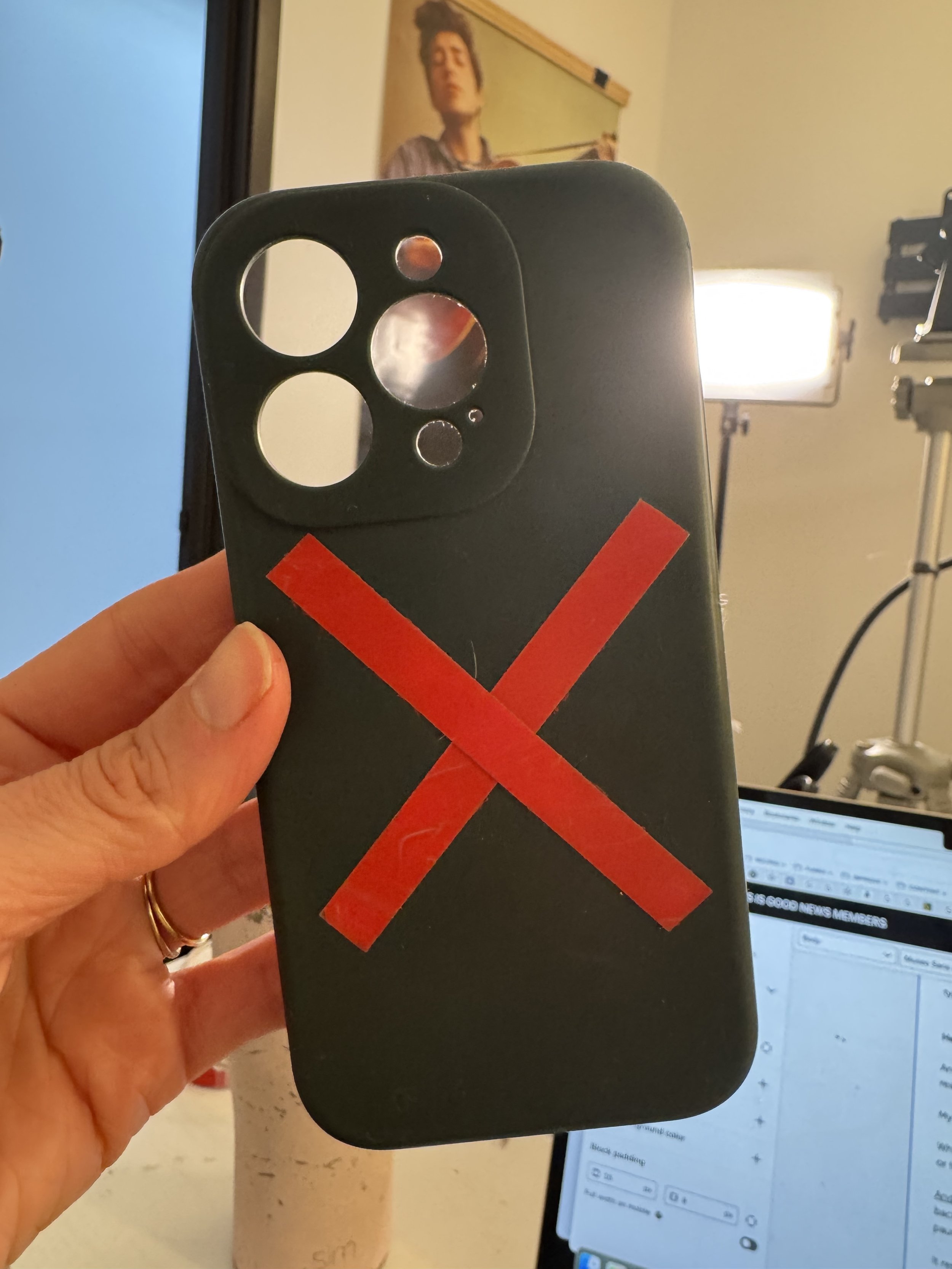
Last year I put a big red X on the back of my phone.
Every time I picked it up, the sight of it interrupted the loop.
And I’d ask myself:
— What would my life look like if I lived in the world instead of reading about it?
— What would happen if my interior world stopped mirroring the chaos of the outer one?
At one point, I even did the Dickens Process (a Tony Robbins exercise where you vividly imagine your worst-case future if you don’t change a behavior).
It’s brutal.
But it clarifies things quickly.
Because the truth is that the world has always contained suffering and always will. And it has always contained beauty, too.
The difference now is access.
We have infinite, on-demand access to the darkest parts.
And when you bathe your brain in that, you live the downstream effects. The same goes for constant short-form video.
It may feel lighter than the news, but it still trains your brain to:
a) avoid thinking your own thoughts
b) crave dopamine spikes that make calm joy harder to feel
So here’s my process.
I'm not going to lie. It's hard, but not impossible. The key is to have something ready to replace your autopilot habit.
PREGAME:
Define your objective. Is it to get off the news? Quit your phone entirely? Or stop using another app? These are general rules for my process and they have a specific objective in mind: Break the news-habit cycle, use phone as communication tool only. Yours might be different. Just define specifically or this won't work.
Step 1: Get a real alarm clock.
Your phone does not get to be the first thing you touch every day. This is psychologically important and will set you up for success.
Step 2: Turn off ALL notifications. You don't need notifications from the Alaska airlines app about sales multiple times per day.
Schedule the truly important notificatiions for a set time when you’re okay being interrupted (I recommend after 12pm or even better at the end of the day).
Step 3: Turn your phone to grayscale.
My friend Annie suggested this. It works.
Step 4: Give your phone a home.
When you get home, it goes there.
When you’re working, it stays away from you.
Simply not having it within reach changes your behavior.
Step 5: Every time you feel the urge to pick up your phone
(research says around 100+ times a day),
pick up your book instead.
(Which means: your book must be near you at all times.
If it’s too big to carry around out and about, use your Kindle.)
Step 6: Block sites if needed.
Freedom or Cold Turkey for laptops.
Opal or ScreenZen for phones.
I personally don't like these types of apps and I don't need them, but they work for some people.
Step 7: Put a red X on the back of your phone.
Use tape. It creates a pattern interrupt.
And every time you see it, ask:
What am I missing if I stay addicted to this?
ANSWER:
(Thinking my own thoughts.
Doing something genuinely worthwhile.
Time with my kids.)
A few swaps that make this livable:
Instead of podcasts → audiobooks.
Yes, it still uses your phone. But long-form narrative calms the brain instead of fracturing it.
Download Libby so you can use your public library. And you can listen to some older books on Youtube but don't go down a rabbit hole (which is nearly impossible not to do, obviously, so just know thyself).
When you’d normally scroll around your kids → play music in your house from real speakers, not your laptop.
Let your brain have stimulation while staying present.
Don't take your phone in the bathroom. Just don't.
The first week (or two, if I’m honest) is really hard.
You will feel compelled to check your phone for absolutely no logical reason.
But by week three, you won't even notice.
Add this, too:
Go for walks without your phone.
Be amazed at the thoughts/ideas you have that generate from your own mind!
And here’s the payoff:
When you stop splitting your attention into thousands of 3-second fragments — headlines, clips, random cat videos if that's your thing — something profound happens.
Your brain quiets and your focus returns.
Your attention span lengthens.
Your dopamine resets.
You become sovereign over your own attention.
You feel… saner.
If you want to do this with me, reply to this email and say “red X.”
I’ll send weekly pep talks. I don’t care if only two or three of you reply — I’ll still check in.
This isn’t about being Ted Kaczynski, a Luddite, or totally anti-tech.
It’s about being free.
And in 2026, that might be the most radical thing you can do.
XO,
